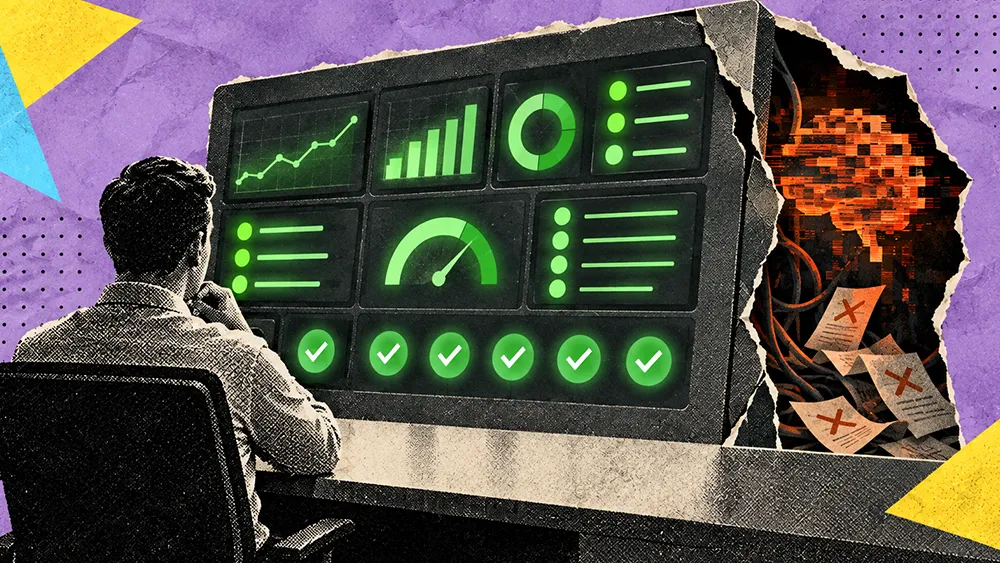
AI ROI Stays Elusive When Enterprises Measure Technology Deployment Instead Of Decision Intelligence
Wendy Turner-Williams, Chief Data and AI Officer at SymphraAI, on were enterprise AI transformations are stalling on ROI as leaders measure technology deployment instead of the decision quality.


Global AI spending is expected to exceed $2.5 trillion in 2026, and boards are demanding measurable returns. But most organizations are tracking cost savings, productivity, and revenue growth while missing the systemic value AI actually creates: faster decisions, better risk identification, deeper knowledge utilization, and the workforce readiness that determines whether any of it gets adopted at all. The result is that companies keep deploying technology without evidence that it has moved the business.
Wendy Turner-Williams is Chief Data and AI Officer and Co-Founder at SymphraAI, an enterprise intelligence company that helps boards and leadership teams make defensible decisions about AI, data, transformation, and risk. She previously served as Chief Data and AI Officer at Tableau during its Salesforce integration, led enterprise data and AI strategy at Salesforce, and spent nearly a decade as VP of enterprise data and AI management at Microsoft. She previously told CIOnews that orchestration across business workflows was the key to unlocking AI value at scale. This time, she turned to what organizations should be measuring in the first place.
"Very few people are measuring things like decision quality or decision velocity or knowledge utilization or risk reduction or opportunity identification," Turner-Williams said. "There's this gap in how we're enabling employees around return on intelligence versus ROI."
The distinction is not semantic. Traditional ROI captures financial returns, operational efficiency, and headcount changes. Return on intelligence captures whether the organization is actually making better decisions faster, reducing risk exposure, and utilizing knowledge that previously sat dormant. Turner-Williams said the scale of change in AI transformations exceeds what standard investment tracking can measure, which is why leaders keep throwing technology at problems without evidence of progress.
Value thesis before use case: Turner-Williams said leaders need to define what they want to achieve before selecting the technology to achieve it. "Not 'can we use AI in customer service,' but 'can we reduce customer resolution time, improve satisfaction, reduce agent burnout, lower compliance risk without degrading trust,'" she said. "Those are things you can measure because you have an objective." Without that specificity, pilots proliferate without outcome-driven expectations.
Baselines and value leaks: Before approving any pilot, Turner-Williams argued that leaders need to build the "before state." What is the current cost, cycle time, error rate, and human effort? Without a baseline, no ROI story is credible. She also pushed leaders to identify value leaks in advance: trust deficits, adoption gaps, workflows that do not change, managers who do not reinforce new behaviors. "If AI works technically, ask what would prevent value from reaching the business," she said.
AI treated as a science experiment: Turner-Williams said most organizations treat AI as a technology experiment when it needs to be a workforce enablement and workflow redesign initiative. The difference is structural. A technology experiment measures system performance. A workflow redesign measures whether the end-to-end business process improves across every team and system it touches. "Just because you applied an agent doesn't mean employees are using it or incorporating it in their decision process," she said. "AI ROI depends on adoption. And adoption depends on trust, and trust depends on transparency, enablement, and accountability."
Turner-Williams closed with a chain of accountability that she said every organization needs to build before scaling any pilot. Each stage of the end-to-end business workflow requires clear ownership: who owns the business outcome, who owns adoption, who owns trust and risk, who owns measurement, and who owns the decision to scale. The names change at every workflow stage, but the chain itself needs to hold from investment through implementation through adoption through measurable business impact.
"There's a chain of accountability that goes from investment to implementation to adoption to trust to measurable business impact," Turner-Williams said. "You need that chain at each workflow stage across the board. Otherwise, you have leaders randomly throwing pilots at things without any baseline conversation about the lifecycle of those changes, the adoption, the measurement, or the trust."

If this caught your attention, that’s not accidental.

The best editorial systems don’t happen by accident. Outlever builds them.