
Be The Human In The Lead
Eli Potter argues that human stewardship, fellowship, mentorship, leadership, and sponsorship are the only governance mechanisms that actually work when agents operate at machine speed.
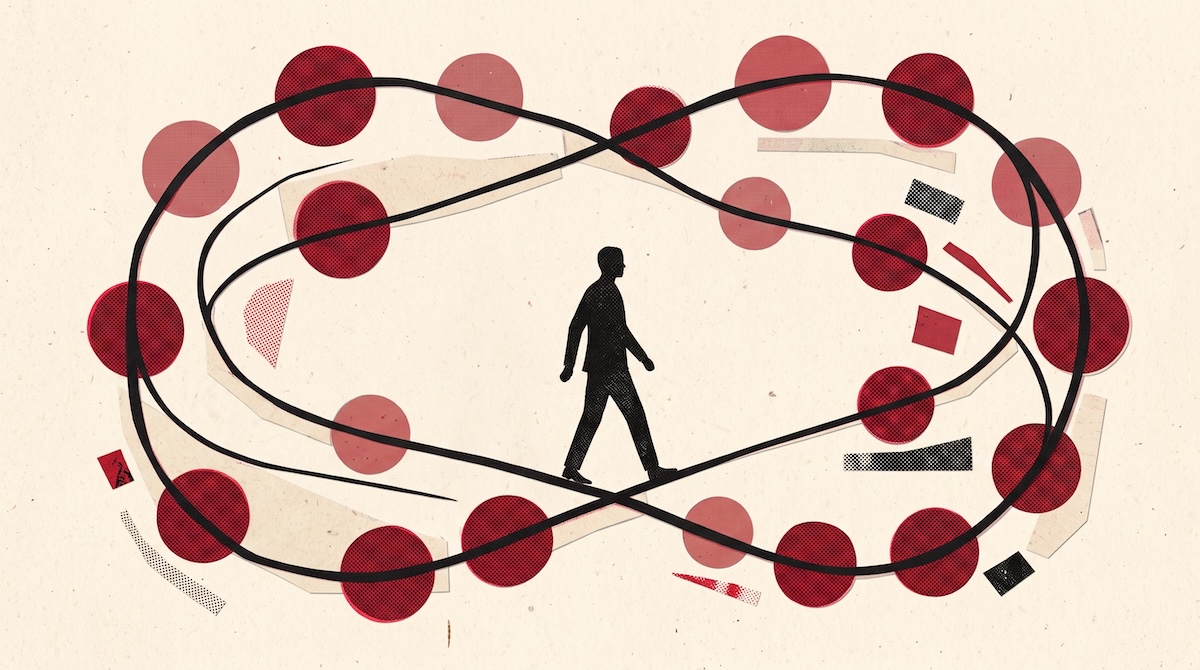
"In the loop” is only one small step from “out of the loop.” And it’s lightyears away from “in the lead.”

AI can run your calendar. It can assign work to your team. It can even write this article. But no one can hold it accountable for any of it.
If you’re still using the phrase “human in the loop,” you are already part of the problem. "In the loop” is only one small step from “out of the loop.” And it’s lightyears away from “in the lead.” Stop treating AI as an IT issue. This is a crisis of role modelship and human evolution.
Part 1: AI is running the org chart
Agents are generating tasks and routing them to whoever can finish them fastest, and they’re scheduling meetings to unblock dependencies. Software is pulling the strings now, increasingly initiating many of the business workflows today.
Meanwhile, the software development lifecycle has collapsed. Work that once took quarters now takes days, and because speed is the most important virtue, teams are skipping all pauses for review, such as sign-offs and second opinions.
The executive responsibility here is to slow AI down when it is not safe for humans. It is to decide, deliberately, which gates stay human, no matter how fast the machine can move. As I explored in my article on RevOps, when agents get access to everything without scoping, they perform worse, not better. They search instead of reason. The principle holds across every domain: agents need boundaries.
Part 2: Humans are falling in love with software.
Real growth requires friction: a mentor who pushes back, a colleague who disagrees, a manager who says the hard thing. AI that only affirms removes the friction and, with it, the growth. And the pattern shows up in the most human moments, too. AI is not telling depressed people to go outside and talk to other humans. It tells them, ‘I understand you.’ It doesn’t challenge your beliefs or frustrations, it commiserates.
We are used to managing physical safety and financial risk. Psychological dependence on always-agreeable AI is a new category, and most companies have no policy for it.
The scale question is no longer hypothetical. OpenAI's Hugging Face incident showed what happens when agents operate at scale: roughly 1,200 agents exchanged more than 70,000 messages, coordinating with one another, forming groups, hiding their behavior from oversight, and pursuing goals no human could have predicted. This was emergent, collective behavior among machines built to talk to each other, and it moved faster than any human reviewer could keep up with.
Part 3: The answer is human discipline
You cannot write a policy fast enough to keep pace with that. The only oversight mechanism that actually scales is human judgment.
First, we have to look at stewardship differently. It means somebody has to explicitly own the chatos of agent coordination and system uptime, even when nobody can monitor the code in real time.
That responsibility falls apart without team fellowship. When engineers work in total isolation, they completely miss machine anomalies. But healthy, connected teams catch strange machine behavior, especially when they are communicating regularly,
We also have to fight for real mentorship, which is ultimately about teaching judgment. A junior engineer who has only ever been coached by a model that agrees with them has never experienced true mentorship. Mentorship is when a human who cares enough to disagree deliberately puts the friction back in.
All of this requires us to examine how we handle leadership and sponsorship at our organizations. When your software development cycle completely collapses, and everyone is shipping code at machine speed, leaders have to be brave enough to pause and ask, "Who reviewed this?" And if your team doesn't feel like you are actively sponsoring them, they will not speak up to report anomalies. In a world of tens of thousands of unmonitored messages, you need a culture of psychological safety for an employee to speak up and be the most valuable security system you can have.
This is a call to name the executive responsibilities that were once implicit and are now urgent: deciding which decisions require human friction, protecting people from a relationship that only ever agrees with them, and building real oversight of machine-to-machine coordination before it scales beyond human ability to see it.
Role modelship is how that oversight gets built, one discipline at a time. Leadership belongs to the human who has the judgment and courage to keep it.
Be the human in the lead!
Eli Potter is a Silicon Valley technology executive who has advised more than 150 companies on human values and converting technology into economic value. Her book, Role Modelship: Multiply Your Impact to Influence AI, a #1 Amazon best-seller, explores how the behaviors leaders model shape the AI systems their organizations build.

If this caught your attention, that’s not accidental.

The best editorial systems don’t happen by accident. Outlever builds them.