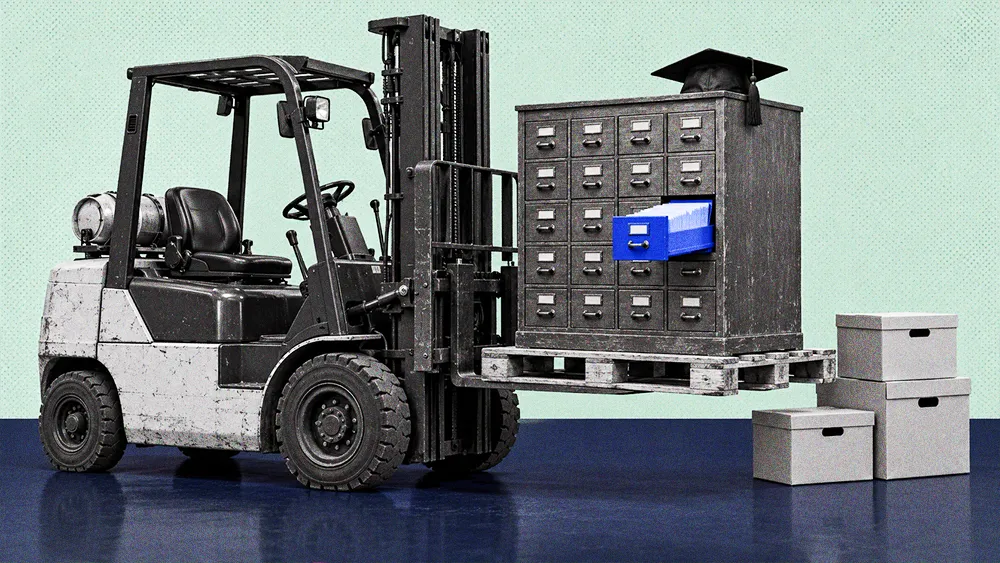
As AI Commoditizes Code, Orchestration Becomes The Enterprise's Center Of Gravity
Nate Busa, a Chief Technology Officer specializing in AI and automation and most recently of NEOM, on why the falling cost of building software rests on orchestration of systems, people, and agents.
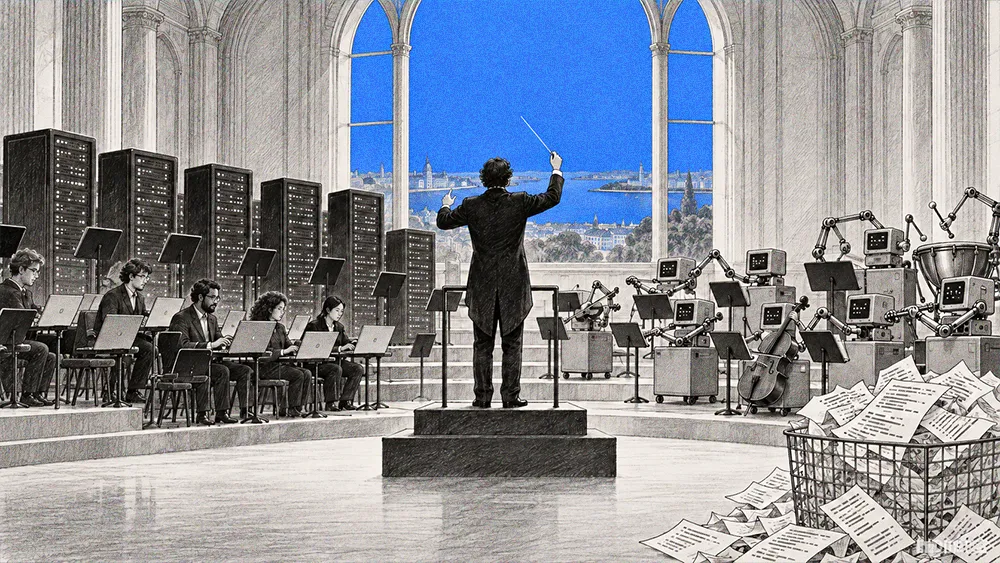

The cost of building software is collapsing, and the work that matters is moving up the stack. As models absorb more of the implementation layer, value relocates upward, to deciding what to build, how the pieces fit together, and who coordinates the result. What comes into focus is a thicker layer of architecture, product, and business ownership, along with a harder question sitting underneath it: who orchestrates the network of systems, processes, people, and agents that the automation leaves behind?
Nate Busa is a Chief Technology Officer specializing in AI and automation, most recently leading enterprise AI and automation at NEOM. Over a career of more than twenty years he has held senior data and architecture roles at DBS and ING, with earlier research and engineering work at Philips and Teradata. Across those roles he's built platforms and teams from concept into production, which gives him a close read on what happens to engineering organizations as the models get better at the work.
"As the process of software creation becomes automated, it pushes the profiles up toward architecture. Rather than starting as a software engineer, you might start as a junior architect or a junior product owner. That layer of connected knowledge gets thicker, because you carry more responsibility for the direction of the company than for writing the software itself," Busa said.
The shift lands unevenly. It rewards the people who can define what a system should do and hold its tradeoffs in their head, and it puts pressure on the rung of the ladder where most engineers used to start. Busa's read is that the pressure is survivable, and that the way through runs on the judgment of the people who've been building long enough to know when the model is wrong.
The economics are already at the board: "We're talking about projects that used to cost between one and ten million dollars, a team of five to ten engineers for six months. That now gets packaged by one or two people plus AI in a matter of weeks," Busa said. The savings are large enough that the tradeoff has stopped being a purely technical conversation and started showing up in front of boards, where the question becomes why headcount shouldn't be swapped for agents. The productivity gains are real but uneven, and they shrink on the hardest problems, which is exactly the territory Busa thinks still needs human depth.
Seniors become the bridge: The gap he keeps returning to is validation, and it's the reason he pushes back on hiring only juniors. "If all you can do is tell the model to 'make it better' and let it run for another two hours, your contribution as an engineer is virtually zero, especially if you don't read or debug the code it produces." A senior who has been able to validate what the model produces carries scarred, embedded experience that an agent can't supply on its own, and that's what makes them the connection between the agents and the business through the transition.
The architecture layer thickens: Busa sees the center of the organization getting heavier, and he thinks most enterprises are already halfway there. "Non-tech enterprises have always relied on external consultants for the implementation layer, so they're already eased into this path. As the delivery layer gets commoditized, that enterprise model becomes the blueprint for far more companies than just enterprises," he said. The flip side is a hard pivot for the implementers and integrators whose business was the delivery layer, and a corresponding pull toward architecture and design for everyone else.
A thicker architecture layer answers who designs the system, but not who makes it run. An architect can define a process and a business owner can define the outcome, and there's still a gap in the middle where a decision made in one system has to execute in a second, update a third, wait on a human approval, and hand off to the next agent in line. That hand-off is where most enterprise automation still breaks. It raises the question sitting underneath all of this: once the network of systems, people, and agents gets this tangled, coordinating it becomes a discipline of its own, and someone has to own it.
Orchestration is the shared discipline: Busa doesn't think the ownership lands on a single new role so much as it gets distributed across the structure that already exists. "The weight is going to be shared. You can't disrupt that level of the company without stalling the entire business," he said. "The departments and the C-suite stay intact. Below that, the layer gets beefed up with more architects, business owners, and operations managers. The interaction between departments stays human, but everything underneath it is increasingly taken over by agents." Keeping that distributed network of coordinated hand-offs coherent is the work that doesn't automate away.
The new path for junior talent: "The junior jumps straight to business owner and architect level in this new world. They don't go into engineering," Busa said. The route up now runs through depth rather than repetition: deep domain expertise in something like supply chain, forecasting, or chemical systems, or a complexity-mastery that comes from understanding every service in a bank or an insurer end to end. There's also a third door for anyone wired for products and ideas. "It's the best time ever to build a company with just yourself and a troop of AI," he said.
Busa's through-line is that automation doesn't hollow out the organization so much as it raises the floor. The rote implementation work compresses, the architecture and ownership layer expands, and the coordination between them becomes the thing worth getting right. For the engineers starting out, the path no longer runs through years of writing code before earning a say in the design.
"The seniors manage and audit the agents through the transition, and in the meantime we grow a new generation of architects and business owners from the ground up," Busa said.

If this caught your attention, that’s not accidental.

The best editorial systems don’t happen by accident. Outlever builds them.