Governed Integration Layers Unlock Manufacturing AI By Standardizing Data Acquisition
Volker Szabo, Head of IT Production Solution Analysis and Strategy Execution at ZF Group, on why enterprise AI stalls in manufacturing until a governed integration layer connects factory-floor controllers to enterprise systems.


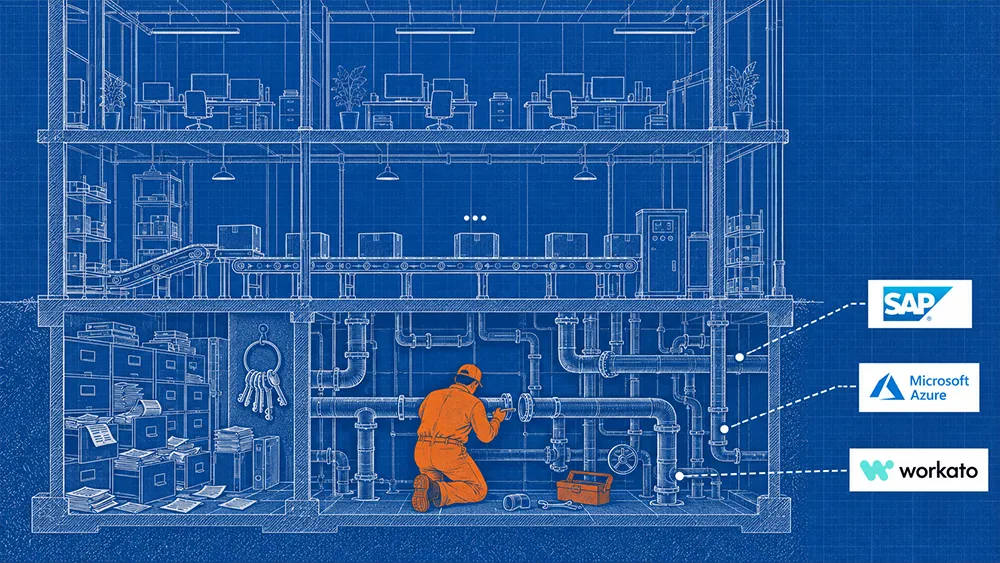
Manufacturing's AI ambitions keep running into the same wall. Decades of point-to-point integrations, layered one on top of another and poorly documented, have left factory-floor systems wired together so tightly that changing a single field in a database can ripple through a dozen others. The data that enterprise AI needs is trapped behind those connections, and the cost of untangling them climbs every year. A governed integration layer, one that connects programmable controllers and SCADA systems to MES, ERP, and cloud analytics, is emerging as the piece that lets manufacturers standardize how data is acquired and orchestrate workflows across the business without ever stopping the line.
Volker Szabo is Head of IT Production Solution Analysis and Strategy Execution at ZF Group, the global automotive supplier, where he leads IT strategy across the company's manufacturing divisions. His two decades in the field span product and demand-management roles on ZF's digital manufacturing platform, smart-manufacturing project work at Brunel, and earlier IT leadership inside the German armed forces. That range, from the shop floor to enterprise architecture, shaped a view in which the technology matters less than the foundation it stands on.
"You can put everything in the data lake, but people don't know where to fish," Szabo said. He pointed back to the big-data wave of a decade ago, when companies poured everything they had into data lakes and then discovered the quality wasn't there, the provenance was unknown, and nobody could say where anything came from. A unified approach to integration paired with a governance framework, he argued, builds a single source of truth over time rather than overnight, and it's the precondition for AI that does more than produce a tidy dashboard.
Spaghetti architecture as the cost driver: In older, larger companies that didn't grow organically, Szabo sees the same pattern everywhere he looks. "The manufacturing environment isn't clean. Everything has been plugged together over 20 or 25 years, not very well documented. We call it 'spaghetti architecture,'" he said. The trouble runs deeper than untidiness. "An interface is not just an interface. It's a combination of a portion of the process, the functional logic, and the interface itself. You can't simply remove one solution and swap in another, and most of the time you can't even change a field in a database." That coupling is what turns routine modernization into a gamble, and it's the point where integration debt starts to compound with every new system bolted on. As Szabo put it, "if you pull at one end, you don't know where things start shaking. You only find out once you've done it."
Start with the nameplate: The instinct to build one grand model is where Szabo sees teams lose months. "There's not one digital twin. You most likely have many, so the first thing is to figure out what you're actually talking about: a product, a machine, a plant, a building," he said. Scope exposes the data problem fast. Pull the bill of materials for a single product, he explained, and you can find dozens of material numbers for what is physically the same part, a master-data mess that has to be cleaned up on the way to any twin. His preferred alternative is to resist the big build and treat it like a measured pilot. "Begin with a nameplate, then add data to it step by step, only from sources you know are reliable. There's no right or wrong path. It depends very much on your environment."
Owners before anything scales: Governance, in Szabo's telling, is not a late-stage control but a first-day design decision. "When you discover the process, the data, and the system landscape, you also have to define clear ownership: who's the data owner or data steward, who's the solution or product owner," he said. The reason is the same coupling that makes the architecture fragile. "If somebody makes a change, you might get a side effect somewhere else. All of that has to be considered. You need a good operational concept, and you need to actively steer these topics, ideally through a product organization." Without that scaffolding, he noted, every improvement carries the risk of breaking something nobody knew was connected.
None of this gets budget without a reason the business recognizes. Szabo is direct that transformation for its own sake goes nowhere: there has to be real pain behind it before anything moves, and the value of the fix has to be visible to the people paying for it. That conviction also shapes how he sets priorities, keeping the heaviest investment tied to business impact rather than to whichever system is loudest. It's why he distrusts strategy drawn from above. ZF's own approach, he said, was to sit with each division individually, map the real architecture at a detailed level, and then ask where each one wanted to be in the medium and long term. The long-term goals turned out to overlap far more than anyone expected, and that shared ground became the roadmap, the commitment, and eventually the funding.
Draw the line deliberately: Standardization only helps when its scope is decided on purpose. "The first question is always: what level?" Szabo said. "Do we enforce the standard at the process layer, the architecture layer? And where do we accept that a plant needs a local adaptation, because not every plant looks the same." He framed the decision against the ISA-95 automation pyramid, the classic model for separating shop-floor control from enterprise systems, and tied the call to hard constraints. "One plant is focused on output. Another doesn't have enough space, so it has to optimize warehouse utilization. You draw the line where cost, security, or reliability demand it, and you stay flexible everywhere else."
Offer a bypass, then rewire: Szabo’s most practical move sidesteps downtime. The machines generating the data are often 10 or 15 years old, long paid off, and still earning in a corner nobody wants to touch. So rather than replace them, he taps them. "You can connect to the PLC and acquire the data without changing anything. The machine still runs, you don’t touch it, but now you have the data in a standardized format," he said. The arithmetic is simple: three ERP systems, four MES-layer systems, and five SCADA solutions mesh into 66 point-to-point connections; one integration layer drops that to 12. "It’s an 80% reduction. That’s not magic, it’s pure math," Szabo said, and the same cut hits maintenance and complexity. Offer the bypass, and the spaghetti rewires into something legible one connection at a time, which is precisely what moving agents into production depends on.
The deeper problem, Szabo believes, is that the industry has standardized everything except the thing that feeds it. Companies consolidated onto single ERP platforms, then chased the one super-process, and are now building data products and semantic knowledge graphs. What almost nobody is standardizing is how the data gets acquired in the first place. "It's like optimizing your entire production system but ignoring logistics. Nobody would do that, it would be the first thing you'd fix. But data acquisition isn't visible. People just see the dashboards."
Left unaddressed, Szabo expects that gap to cap what AI can realistically deliver, for reasons of cost rather than capability. "Without that data integration layer, the really groundbreaking AI won't be worth it. Too expensive, too long, too complex," Szabo said. "The benefits are there already. But the big ones won't be possible until we fix how the data moves."

If this caught your attention, that’s not accidental.

The best editorial systems don’t happen by accident. Outlever builds them.