
When Agents Stall In Production, The Fix Runs Back To Identity, Data, And Integration
TalentXM Founder Suman Gummudala on the sequencing CIOs often skip: settle the foundations, scope the data, then decide whether a workflow even needs AI.
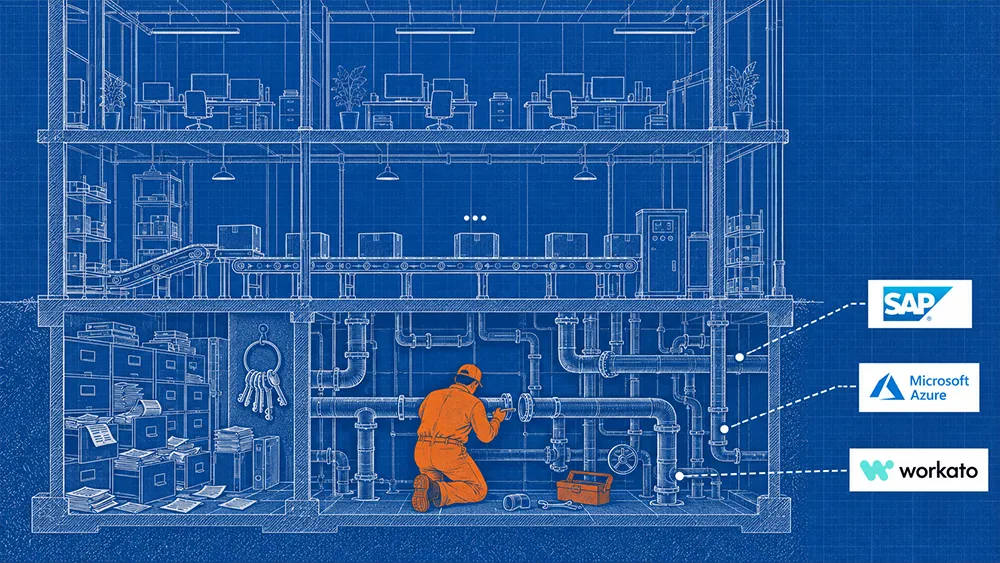
Enterprise agent programs rarely fail at the moment of deployment. They fail earlier: in the integration stacks nobody consolidated, the data nobody governed, and the identities that never lined up across systems. Much of what breaks only shows up once an agent runs against live systems, against the data and connections a demo never exercises. By the time an agent misfires, the real problem has usually been sitting in the foundation for months. Getting past that means treating the foundation as the actual project: settling identity, data permissions, and integration before an agent ever touches a production system, and deciding workflow by workflow whether a task even needs AI at all.
Suman Gummudala is the Founder of TalentXM, an AI-native enterprise services company that pairs AI agents with flexible, on-demand talent models. Over a 15-year career he has led SAP and AI transformation programs across North America, Europe, Latin America, and Asia, working inside the order-to-cash and logistics systems where enterprise integration tends to break first. His read on why so many agent efforts underdeliver starts well before anyone writes a prompt.
"Before you even get into agents, you have to look at the preparation. Did they get the foundations right? The integration, the data governance, and, more importantly, the skills. Companies are so used to organizing around job titles that they don't have a full inventory of 'what skills do we have' and what projects they actually need to execute," Gummudala said. An organization that can't name its own capabilities can't match them to the work an agent is meant to absorb, and it ends up automating around gaps it never mapped in the first place.
A unified stack before more agents: Gummudala points to one failure mode above the others. "The biggest thing they got wrong was agent sprawl. Ad hoc agents started from all over, with no unified place to go." In the case he worked, the company was also running SAP alongside several different integration platforms spread across divisions, none of it looked at as a whole. The instinct to rip out and replace is the wrong first move; the better one is pulling what already exists into a single view, which is the job a center of excellence now does there. It's also where the right guardrails tend to be missing, with only a small fraction of organizations confident they have the governance to manage what they're deploying.
Identity that actually lines up: Agents act with delegated authority, so if the systems underneath can't agree on who someone is, no permission an agent inherits can be trusted. "They had a mismatch between how their Azure Active Directory and their SAP cloud identity services talk to each other, and they're still working on syncing that," Gummudala said. Reconciling that plumbing is unglamorous work, but it's the difference between a written policy and one that gets enforced in the architecture.
Permissions down to the row: "Initially they brought all the data together, and it was really helpful," Gummudala said. "But the more people used it, the more they started noticing people seeing data they weren't supposed to see. We had to step back, get the metadata right, and push those controls into the SharePoint security groups, so access is governed by region and by plant, with role-based, row-level access." For a research-heavy manufacturer with IP it restricts across certain regions, the stakes are concrete: without scoped controls, an internal AI tool quietly becomes a route around access controls the company spent years building.
Once identity and data are sorted, the open question becomes visibility: who can see what an agent is doing, and who answers for it when something goes wrong. Gummudala wants centralized oversight of agent actions, not a scattering of logs, and that need only grows as agents start calling tools and each other through emerging protocols. At that point the entire chain of interactions has to be watchable, not just the individual agent. This is the moment governance stops being a document and has to become something that holds at runtime.
Governance as a daily habit: "People are used to treating governance like the annual compliance course everyone has to finish. With agents, it has to be part of the day-to-day job, because if you don't get it right there's too much risk, and the whole foundation can fall apart," Gummudala said. He runs change management as deliberately as the technical work, building awareness before deployment and giving employees real ownership when an agent acts on their behalf. Not every agent earns the same scrutiny, either: across a few hundred of them, some can tolerate a 10 to 20 percent error rate and some can't, and sorting out that accountability is what keeps oversight focused where the consequences are real.
The economics of each workflow: For Gummudala, the discipline is refusing to reach for AI by reflex. "A tool like Workato lets you go flow by flow and ask whether something even needs a probabilistic search. In a lot of cases, deterministic is far better than AI for the regular tasks." From there it's a running calculation: caching to cut token consumption, cheaper models where an expensive one adds nothing, open-weight models weighed against their GPU and total-cost-of-ownership load, and sometimes a plain machine-learning model instead of an agent at all. Keeping that math honest is the same instinct as keeping spend in check once the usage meter is running.
The thread running through all of it is sequencing. Fix the foundations, scope the access, see what the agents are doing, and only then decide whether a given problem belongs to an agent, a cheaper model, or ordinary automation. The programs that skip those steps don't avoid the work; they just pay for it later, in production, where it's most expensive to fix.
"At the end of the day, each department has to answer: what are the business outcomes, how much did we spend, and what are we getting out of it," Gummudala said. The enterprises that can answer those three questions per workflow are the ones treating agents as a means to an outcome, not the outcome itself.

If this caught your attention, that’s not accidental.

The best editorial systems don’t happen by accident. Outlever builds them.