
AI Decentralizes Software Creation, Forcing CIOs To Redefine Control
Christoph Wargitsch, CEO of Wargitsch Transformation Engineers, on why CIOs must stop trying to control every AI activity and start governing only the elements that actually matter.

AI is reshaping IT into a distributed system of builders, and governance hasn't kept up. As business units start creating their own tools, the CIO’s role shifts from controlling delivery to defining the guardrails that hold everything together. Organizations that fail to make that transition risk fragmentation, stalled transformation, and a widening gap between those moving at AI speed and those stuck in legacy models.
Christoph Wargitsch is the CEO of Wargitsch Transformation Engineers, a transformation consultancy with operations in Germany and Malaysia that helps large enterprises navigate organizational, human, and technology change simultaneously. Before founding the firm in 2008, Wargitsch held senior management roles at Audi, Volkswagen Group, and T-Systems, and currently serves as an Industry Fellow at 42 Wolfsburg & 42 Berlin. His background sits at the intersection of business organizations, IT management, and the messy human dynamics that determine whether transformation programs succeed or collapse.
"AI is changing the whole value chain of IT from ideation to coding itself. Who is actually creating IT or software is much more democratic, and most parts of the industry are not really aware of what that means down to the core of their business," said Wargitsch. That democratization was already underway before generative AI arrived, but the acceleration is dramatic. Business departments are no longer just requesting solutions from IT. They are building their own. And the implications stretch well beyond shadow IT into governance structures that were never designed for this level of distributed creation.
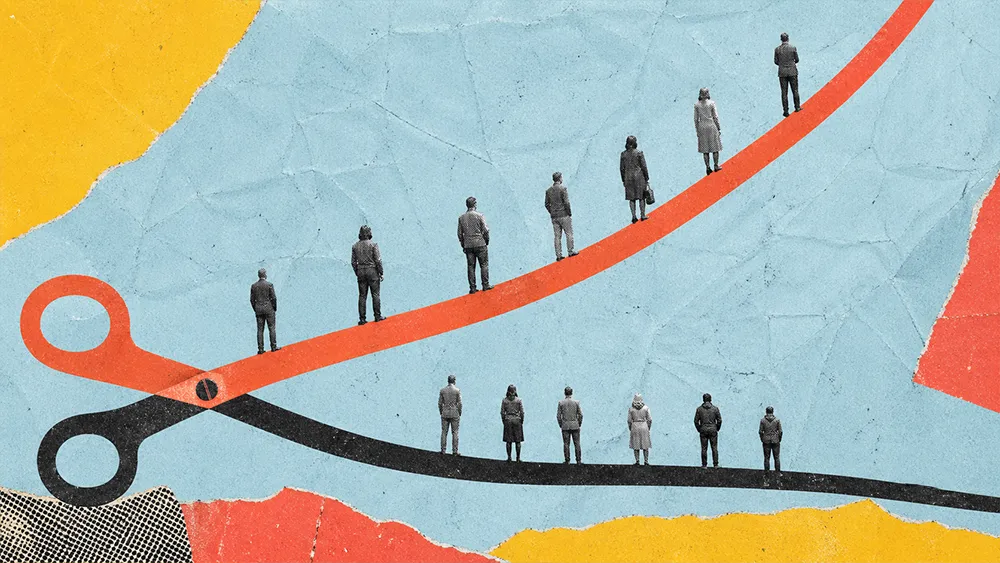
Wargitsch described a growing divide between organizations moving aggressively on AI and those still watching from the sidelines. He called it "the scissor," and it is opening fast.
Survival mode vs. hockey stick: "The technology development is like in a hockey stick mode, but there are still some on a linear mode," Wargitsch said. Mid-sized companies face the steepest challenge. They lack the resources of large enterprises with lighthouse projects and the speed of small firms that can pivot quickly. Economic conditions across Europe are compounding the hesitation. "They know they have to invest, they have to move forward, but they say, 'We are now in survival mode,'" he added. "This will lead to a shakeout in the market."
Monoliths under pressure: The large incumbent software providers are feeling it, too. Wargitsch pointed to the threat facing companies like SAP and ServiceNow as solutions become "much more fluid, much more non-monolithic." When anyone in the organization can build a functional tool without waiting six weeks for IT to provision hardware, the old value chain starts to fragment. Nonetheless, everyone is aware of the risks and imperfections of vibe coding and Open Claw solutions. Some providers, like Salesforce with its Headless 360 architecture, have recently responded by opening up significantly.
The technical integration challenges that CIOs face are real, but Wargitsch was direct that the harder problem is political. Data ownership, process domains, and master data management are governance questions that map to organizational power, not to software architecture.
SOA never went away: "Who is owning a domain and defining a certain data or process domain? This was more or less a power game. And it's the same now with master data," Wargitsch said. The concept of Service Oriented Architecture was popular 15 to 20 years ago, but the underlying governance problem persists. Technically, master data management is solvable. Getting stakeholders to agree on who owns it is where programs stall.
The 10-year migration trap: Wargitsch described clients with migration and decommissioning plans spanning a decade, covering 3,000 to 5,000 applications across regional and local integration points. AI-supported tools that integrate process, data, and workflow visibility can compress those timelines, but only if governance decisions keep pace.
Wargitsch's consultancy researched why transformation projects fail and built a framework around three layers of change: human, organizational, and technology. The pattern was consistent regardless of the technology involved. The speed was the only variable that changed.
Two sources of resistance: "One is you can't explain to the key players what their position is in the new world. And the second thing is the fear to fail because they don't have the knowledge to go that way," Wargitsch explained. When senior stakeholders sit on the sidelines without a clear role in the future state, they disengage. When frontline teams lack training and room to experiment, they slow down the work out of self-preservation.
Alignment-based, not rule-based: Wargitsch drew a distinction between the two approaches that applies across AI governance broadly. Rigid rule-based control cannot keep up with the pace of AI-driven change. Alignment is by far the better approach, achieved through joint strategies, agreed-upon portfolios and roadmaps, as well as strong principles, e.g., how teams should behave and share information. "This is a different type of control, but also a very powerful one," he said.
For CIOs questioning what they should still own, Wargitsch boiled it down to a short list. Enterprise architecture, Orchestration schemes, and master data objects need to be clear because they underpin integration and information flow. Security standards need to be strict and assertive. Infrastructure strategy, including cloud and multi-cloud positioning, needs to be defined. And business cases need to be proven before investments scale. Everything else should run on principles, not permission.
"If you try to control every single activity, every single project, you're either losing speed or you're lost," Wargitsch said. "But architecture, orchestration, security, data objects, master data: this is the minimum you should have under governance. And for the rest, it's alignment-based working, not rule-based working. How do you behave, how do you inform, how should you act. It helps a lot for moving forward effectively, and this is a very powerful type of control."

If this caught your attention, that’s not accidental.

The best editorial systems don’t happen by accident. Outlever builds them.