At Checkers & Rally's, Drive-Through AI Lives Or Dies On The Data Around The Voice
Caio Fernandes, VP of Technology at Checkers & Rally's, on why the voice model is the smallest piece of a drive-through AI rollout, and why the baseline and the trusted data around it decide whether it pays.
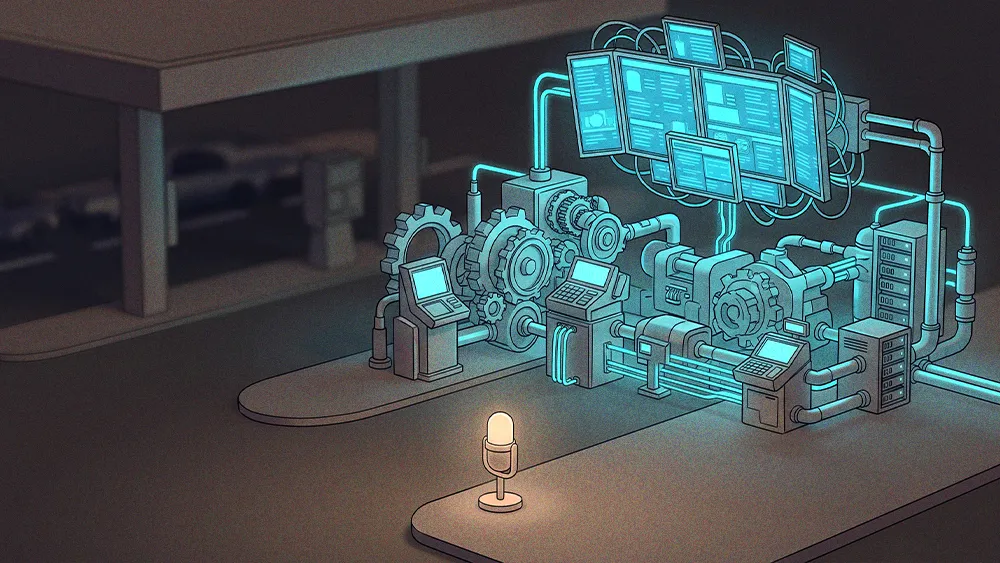

Most quick-service chains that put AI in the drive-through did it to reduce labor cost, which is one of the three largest components of a restaurant P&L. However, a fair number noticed they were measuring the wrong thing. The voice ordering model is the AI part, the piece that turns a spoken order into a ticket, and it's also the part that matters least to whether the deployment pays the ROI. The return, and the difficulty, lay in everything the model touches: the point-of-sale, the speed of service timers, the digital menu board, the confirmation screen, the loyalty data, and the analytics layer where it either becomes actionable intelligence or just another set of numbers no one trusts. Across the quick-service industry, the framework has started expanding from speed of service toward precision, and that shift lives in the data, not the microphone.
Caio Fernandes is Vice President of Technology at Checkers & Rally's, where he oversees enterprise technology across more than 700 corporate and franchised drive-through restaurants. He previously served as Chief Information Officer and led digital technology at Bloomin' Brands, the parent of Outback Steakhouse, and held a senior IT role at Arcos Dorados, McDonald's largest Latin American franchisee. At Checker's & Rally's he inherited a drive-through voice AI program that had already run for about three years, along with a chance to re-examine what it was actually delivering.
"The AI itself, as well the machine learning (ML), is not extremely leveraged in the first phase of a project like this," Fernandes said. "What we're trying to do first is to understand what somebody's saying, convert that to an order, and apply some rules. This task relies more on the LLM (Large Language Model) piece." That's the whole job of the voice layer, and it's close to a solved problem. Everything that determines whether the investment earns its keep sits in the systems around it, which is where the team focuses its attention.
Depending on the QSR operational model, the labor case may turn out to be a weak one: Voice AI arrived almost everywhere as a labor story, and on a drive-through crew that logic mostly collapses. A lean operation runs a handful of employees, and part of their time goes to work on no-order-taking. "AI voice ordering will not impact the non-productive time," Fernandes said, pointing to restocking, cleaning, and closing tasks that fill a shift. Crew size decides how little there is to save. A McDonald's dining room might run thirty employees, where one position is a rounding error; a drive-through with four is a different equation. "You have an operation with four employees, and one head is 25%," he said. Checkers stores run leaner still, roughly two to six employees on a nearly all-drive-through model, so the savings a labor business case assumes are thin from the start. The gains that do show up land elsewhere, in speed of service, order accuracy, customer satisfaction, and upselling.
Baseline before you pilot: None of those gains are provable without knowing the starting point in detail. Before touching the process, Fernandes wants a sales forecast the team trusts, a labor guide built on fifteen-minute scheduling intervals, and hard current numbers on speed of service and order accuracy, so a pilot has something to be measured against. Only then does a mid-volume store run for a full cycle of at least a month, long enough to capture seasonality and weekend rotation, before the test widens to stores with different volumes and crews. The team learned the cost of skipping it. "We removed it from a few locations and re-baselined them, because that baseline had been lost," Fernandes said. Recovering the measurement, and benchmarking against it properly, is what turned a running deployment back into something the business could actually evaluate.
Getting the baseline right is a discipline problem, a matter of forcing the measurement to exist before anyone touches the process. Getting value out of what the deployment produces afterward is a different kind of problem, and a harder one, because it depends on data rather than resolve. Every touchpoint the voice system connects to starts throwing off information the moment it goes live, but that information only becomes useful if it lands somewhere trustworthy and comparable across hundreds of stores. That's where most of the effort goes once the pilot is behind you, and it's where the drive-through either turns into an intelligence engine or remains just a different way to take the same orders.
The data is the hard part: Integrating the voice system with the POS, the timers, and the menu board is largely a one-time job, and most vendors already handle the common POS platforms. The difficulty starts once every touchpoint begins emitting information that has to travel above the store into analytics, in Checkers' case a Snowflake environment, and arrive in a form people believe. That's the system around the model where the payoff actually accrues. "That's where all the gold sits," Fernandes said of the data layer, the place where a team can see why speed of service diverged across locations or why a promotion moved it. A dynamic menu board with an order-confirmation screen adds a second sense (vision) to the interaction, lifting accuracy and handling regional accents and the Spanish-and-English mix his customers actually speak, none of which the voice model catches on its own. The persistent question underneath it is whether the data can be trusted. "Are you sure the data is coming in validated and curated, in a format people trust? Can I trust this data? There are a lot of questions like that," he said. Standardizing the backbone, one POS and one back-of-house system across the fleet, is what keeps the answer yes, because it makes every store's data comparable when it reaches corporate.
The human handoff has a long tail: Where an operator lands on autonomy shapes both cost and durability. Some vendors hand over a fully autonomous system; others run near ninety-percent accuracy and route the interaction to a human when confidence drops or the request leaves the script. The more capable version keeps that human off the store floor entirely, in the vendor's own call center, where the same team that rescues the order also feeds the failure back into the model faster than a store ever could. But the hidden cost surfaces later. As crews turn over, the person who once took every order never learns to, so the fallback skill decays and the humans meant to catch the model are less ready than the ones who preceded the rollout. "You end up absorbing a responsibility on the technology side that starts to get lost in operations over time," Fernandes said.
The economics also refuse to generalize, which is where the franchise model requires special attention. A corporate operator can absorb one pricing structure across large and small stores; a single-store franchisee running low volume cannot, and pushing the same deal onto them can stall adoption or worse. That makes the rollout strategy just as critical to success as the technology itself, and it argues again for understanding the full picture before committing. "Once you understand the change fully, the impact, that's when you understand what the business case return is," Fernandes said. For a drive-through operator, that understanding is built out of data long before it's built out of a voice.

If this caught your attention, that’s not accidental.

The best editorial systems don’t happen by accident. Outlever builds them.