
Smaller AI Agents With Clear Jobs Keep IT Operations Running Around The Clock
Ranjith M. Nair, Principal Product Architect at UST, on why small, focused AI agents inside structured orchestration keep IT running overnight.
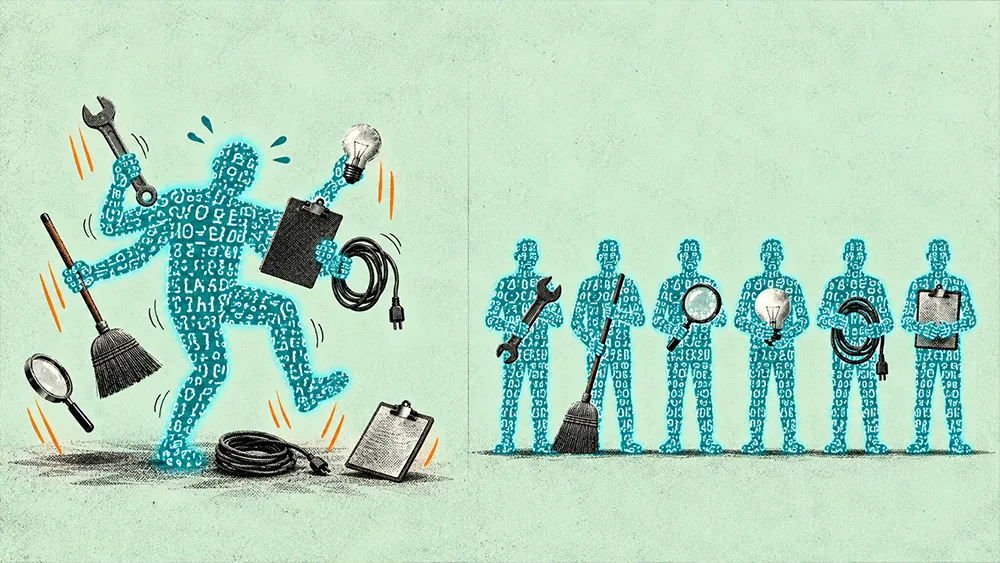

The fastest route to IT operations that run on their own overnight is to give AI agents less to do. A small agent with one clear task behaves predictably, and teams trust predictable systems when no one is watching. People stay involved and step in to make the decisions that need their judgment.
Ranjith Nair is a Principal Product Architect at UST, a digital transformation and IT services company. He leads architecture and technology strategy for UST’s AI operations platform and works with enterprises as they bring it into their IT environments. Nair has spent more than 28 years in software engineering and architecture, including early roles at IBM and Verizon, and is a named inventor on two U.S. patents in workflow automation and event intelligence. He has seen that how a team designs its agents matters more than how many it runs.
“Line up your agents first, and then put proper orchestration around them,” Nair said. With the agents defined, orchestration manages the flow of work between them and decides what happens at each step. That design work starts well ahead of the first agent.
Start with the groundwork: Before automating anything, teams need to rethink how their operations run. “Is it just about automating? It’s more about how you reimagine all these areas, so you reduce a lot of cost,” Nair said. The rethinking starts with data. Most enterprises run separate tools for infrastructure, networks, and applications, and each one does its job well but sees only one slice of operations. Bringing that data into one place gives teams and their agents a full picture. Documentation and logs need attention too, since many teams have kept them inconsistently and agents can only work with the information they receive.
Orchestration stays in charge: Orchestration needs to be deterministic so teams always know what the system will do. Agents handle the parts of a task that call for judgment. Restarting a server is a simple example. “If I have to restart a server, that’s a very simple thing I could do with a workflow or a script. But if the procedure isn’t clear in the knowledge base, you might need an agent. Put the agent in the right place and orchestrate it with the normal workflows,” Nair said. Each piece does the job it suits best, and orchestration keeps them working in order.
Small agents, clear jobs: One agent handling many tasks has a lot to keep track of, which leaves more room for it to go off course. Smaller agents with specific assignments are easier to predict. “Keep the agents light and small, and give them the proper context. Then they work on that context,” Nair said. Running many agents isn’t a problem in itself. Each one needs the right information passed to it at every handoff, whether the handoff is between two agents or between an agent and a person. Clean handoffs mean no agent has to guess what it’s supposed to do.
Deciding where agents belong also means deciding where they don’t. Agentic AI is moving quickly into the software enterprises already use. Gartner expects a third of enterprise applications to include it by 2028, up from less than 1% in 2024. As agents become a standard feature, CIOs face a more practical question. They have to decide what tasks need AI at all.
Right tool, right job: Some work can only be done with AI. Network prediction in telecom is one example, since neither a person nor a fixed program can keep up with it. Many other tasks run fine on a workflow, a script, or an API call. Teams with more AI experience can tell the two apart. Nair is flexible about labels when he presents a design to leaders. “I don’t mind calling a particular workflow an agent. One is a bot; one is a workflow. It doesn’t matter. Both are agents. They’re doing their job, and they’re working for you,” he said.
Humans on call: In this model, people stop approving every step. The system runs on its own, and when it needs a person, an agent has already tried the available fixes and looked up the standard procedures. “A supervisor agent decides how to use the human, where to involve them, and where to stop and resume,” Nair said. The person gets a recommendation and can respond by voice or through a ticket, and the agent picks the work back up from there.
Oversight for agents: Monitoring has to cover agents too. IT teams have long tracked infrastructure and applications, and now agents need to be checked and verified as well. That job can also go to an agent. “Can that be another agent who monitors these agents? Quite possible,” Nair said. Monitoring agents can review the work of other agents and flag problems on a shared dashboard. People can then look at what the agents found and act where needed.
Enterprises can bring agents into IT operations without rebuilding their architecture. The systems they already run stay in place. Agents and workflows take on more of the routine work, and more of that work runs through APIs where it once ran through user interfaces. The teams that get the most from agents focus on stability. “At the end of the day, everything has to keep working as usual. The enterprise is always on,” Nair said.

If this caught your attention, that’s not accidental.

The best editorial systems don’t happen by accident. Outlever builds them.