Fossils, Foxes, and the Future of the CIO
There's no standard pipeline for developing CIOs. Stuart Evans explains why seasoned leaders and AI-native technologists need each other, and what CIO development should look like moving forward.
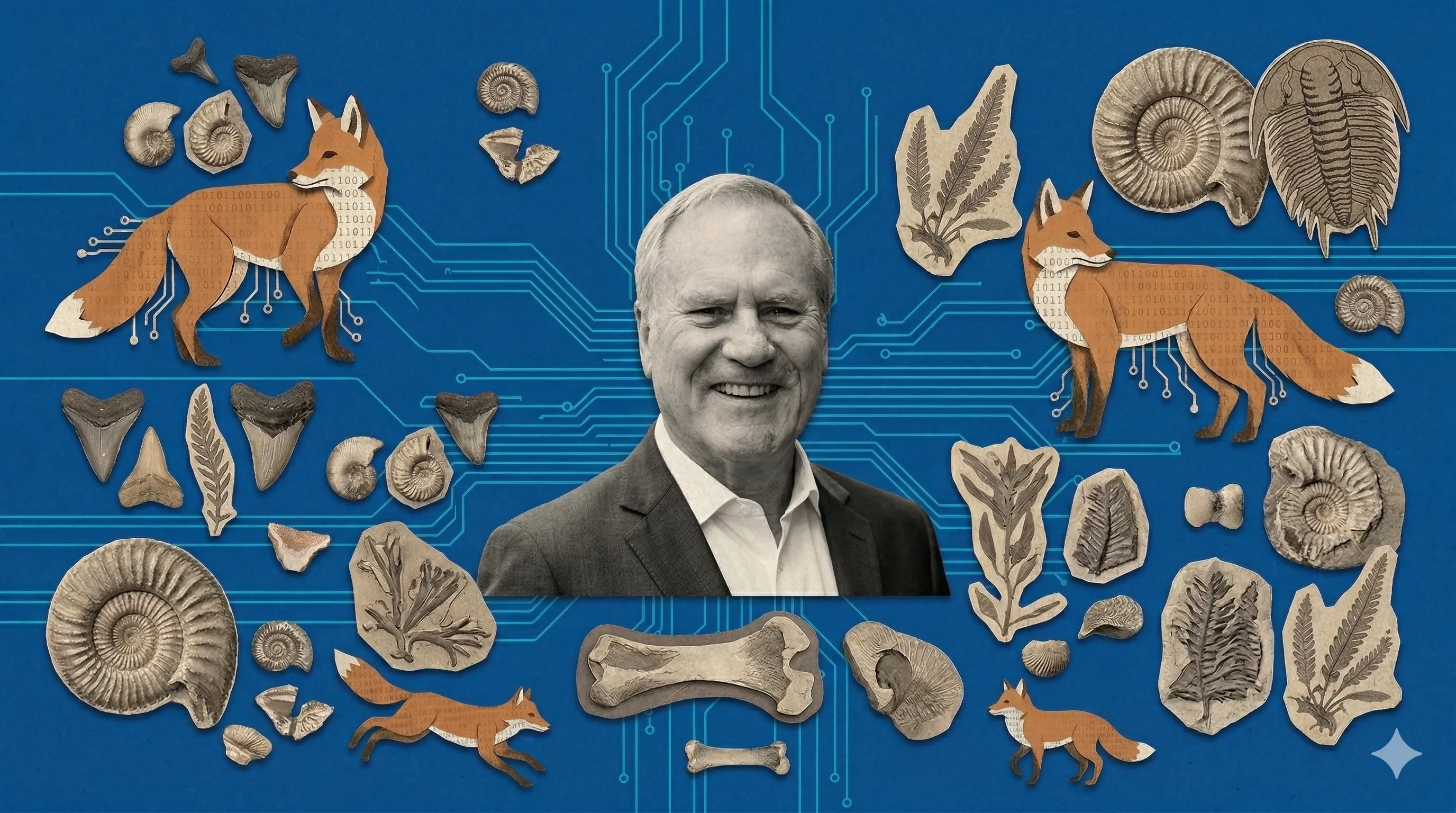
"The best boards I advise are pairing a seasoned technology leader with someone a generation younger who has been deep in AI for years. Rather than mentorship, this is a genuine partnership where each side brings something that the other cannot. The fossil brings judgement. The fox brings fluency."

This is the leadership question that worries me most: are we developing the next generation of CIOs? The universities aren’t producing them. There is no standard entry-level CIO training pipeline the way there is for, say, finance or consulting. Most CIOs got there through some combination of technical depth, political skill, and being in the right place at the right time. That worked when the role evolved slowly. It doesn’t work when the world frequently shifts kaleidoscopically.
I spent 17 years teaching software engineers and technologists in Pittsburgh and at Carnegie Mellon’s Silicon Valley campus. I watched the CIO role transform from keeping the lights on to setting the strategic direction of the enterprise. And what I see now is a widening gap between seasoned CIOs who built their careers in a world that no longer exists, and a generation of younger technologists who live natively in the new world, but have never run anything at scale. I call them the fossils and the foxes. And right now, neither group has what it takes alone.
The fossils are the experienced CIOs. They’ve survived migrations, mergers, outages, and boardroom politics. They know the dynamics of an organization, the unwritten rules, the difference between launching a project and getting it across the finish line. That institutional knowledge is irreplaceable. But many are watching AI reshape their enterprises from the outside. They’re reading about agentic AI in analyst reports instead of experimenting with it directly. The most fossilized are retreating into what they know, waiting for clarity that isn’t coming.
The antidote is simple. The first step is to get your hands on the tools your engineers are already using. You don’t need to become an expert. You need enough firsthand experience to ask the right questions. As Workato CIO Carter Busse recently put it, you cannot delegate this. You need to be in the tools yourself, building and experimenting, not waiting for a consultant to tell you what to think.
The foxes are different. They’re the late-twenties and early-thirties technologists who have been living inside these tools for five years. They don’t need a briefing on what Cursor or Windsurf can do because they’ve already built with it. They understand how AI changes the speed and shape of work because they’ve experienced it firsthand. What they lack is context. They haven’t navigated a failed ERP rollout. They haven’t managed a thousand-person IT organization through a recession or a global pandemic. They don’t yet understand, at least not through experience, that getting things done in a large enterprise is harder than coming up with the idea in the first place.
The best boards I advise are pairing a seasoned technology leader with someone a generation younger who has been deep in AI for years. Rather than mentorship, this is a genuine partnership where each side brings something that the other cannot. The fossil brings judgement. The fox brings fluency.
I saw this firsthand when I directed the CMU-Emirates iLab in Silicon Valley. A group of PhD students working on machine learning and drone technology partnered with Emirates’ warehouse manager, who told them he had nightmares about his people searching for lost packages in air cargo facilities that still relied on manual processes. Within weeks, the students had prototyped an automated tracking system. The foxes saw the technology, the fossils saw the problem. Neither would have gotten to this solution alone. This story also illustrates the gap that still exists: the team couldn’t get the project funded internally because Emirates evaluated it against traditional ROI metrics designed for existing operations. That mismatch between innovation and institutional measurement is exactly what fossil-fox partnerships need to solve. Together they have a chance. Apart, the fossil gets disrupted and the fox gets overwhelmed.
We need to formalize CIO development. CIO leadership development should look less like an MBA curriculum and more like an apprenticeship that bridges generations. One of the best programs I’ve seen is at the University of St. Gallen in Switzerland, which treats CIO development as a discipline in its own right. CMU’s Heinz College also has excellent Masters programs in IT. In my own courses at Carnegie Mellon, especially our class on NexGen CIO’s, I brought CEOs, CIO’s, CISO’s, venture capitalists, and enterprise technology leaders directly into the classroom to work alongside students. We examined real problems with the agentic enterprise with AI use cases in healthcare, finance, manufacturing, and customer service. That combination of practitioner access and hands-on building is what's missing from most CIO pipelines. We need more of that and we need it to include the lived experience of working with AI, in addition to the theory of managing it.
The CIO role has always demanded two opposing capabilities at once: hold steady enough to protect what works and move fast enough to seize what’s new. I’ve spent years studying this tension and I call it super-flexibility; the ability to shift gears and adapt realtime when things change. It’s the reason the foxes and the fossils need each other. Robustness without agility is a recipe for irrelevance while agility without robustness is chaotic. The CIO of the future has to do both and no one develops this range in isolation.
So here’s my challenge to the CIO community: if you are a fossil, find your fox. If you’re a fox, find your fossil. The world is changing too fast and too fundamentally for either of you to figure this out alone. We are at the end of the old way and the beginning of the new. The leaders who bridge that gap will define what comes next.
Stuart Evans, Ph.D., recently retired as Distinguished Service Professor at Carnegie Mellon University’s Integrated Innovation Institute, where he taught innovation and entrepreneurship for 17 years. His research on super-flexibility and dynamic adaptation draws on a career spanning SRI International, Stanford Graduate School of Business, Bain and Company, Sand Hill Venture Group, and Shugart Corporation (Xerox). He previously taught at Cambridge University’s Judge Business School.

If this caught your attention, that’s not accidental.

The best editorial systems don’t happen by accident. Outlever builds them.