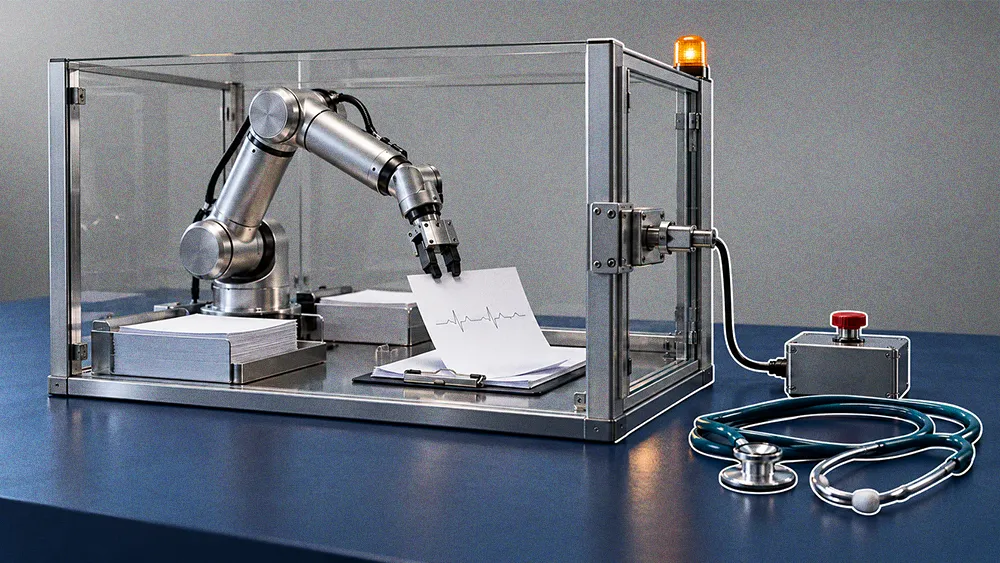
DHL Supply Chain Scales Digital And Physical AI Through One Innovation Funnel
Christophe Theys, Global Head of AI, Data & Analytics at DHL Supply Chain, explains why the company runs software agents and warehouse robotics as a single program, and the deployment discipline that decides which solutions earn a global rollout.


In large-scale supply chain operations, the value of enterprise AI is increasingly coming from the combination of two capabilities that are often pursued on separate tracks: software agents that automate decisions and the flow of information, and physical automation that moves goods through a warehouse. Holding both under one strategy, governed by a single set of rules about what gets built and what reaches full deployment, is what lets them compound instead of splitting the roadmap in two. Getting there takes a deployment discipline strict enough to tell, early, which ideas can scale across hundreds of operations.
Christophe Theys is Global Head of AI, Data & Analytics at DHL Supply Chain, the contract logistics division of DHL Group, where he leads a global team across operations in roughly 50 countries. He built the function from its first employee into a multidisciplinary department spanning data architecture and engineering, data science and AI engineering, automation, and data and AI governance, and he now sits on the company’s Global IT Management Board. His starting point is a deliberate choice to stop treating the two sides of AI as different problems.
"We don't just have a digital AI agenda with agents, and we don't just have a robotics agenda. For us, it's that combination, and we follow one approach for both the digital AI and the physical AI. That's really what proves to be valuable," Theys said. The combination rests on scale that's already in production. DHL Supply Chain runs more than 1,400 deployments of advanced analytics and AI across its network, more than 500 of them this year alone, and operates over 9,000 robots worldwide. Theys' argument is that holding both under one strategy, rather than two competing roadmaps, is what lets them reinforce each other instead of pulling for separate budgets and attention.
One funnel for both: The mechanism underneath the strategy is a single pipeline that every idea travels, whether it ends as a line of code or a machine on a warehouse floor. "It's one strategy and one approach, what we call 'digital by default,' with a single innovation funnel for the physical and the digital," Theys said. "Every idea starts in research, the successful ones move to a proof of concept in a controlled live operation, then to productization, and then we deploy at scale." Three gates decide what advances: a use case has to solve a real business problem or customer need, it has to show measurable value, and it has to carry a credible path from a promising pilot to broad rollout. "If something is only applicable to a handful of our operations, that's not something we would advance in the funnel and roll out at scale."
The data underneath: Ask Theys what makes the funnel work and he points to the layer that gets the least attention. "Data is the element we don't talk about enough, and more than ever, it's the real foundation for everything we do with AI," he said. "What we're able to do today, we can do because of the data decisions we took many years ago." That foundation at DHL Supply Chain is a lake house architecture combining a data lake with data warehousing, master data management rolled out at scale, reference data standardization, semantic models, and data governance. The semantic layer is what lets agents operate in a business the size of DHL's, and it's the same piece that outside research keeps naming as the obstacle most companies hit when they try to move agents past a pilot. "Agents need that semantic layer, they need that context and that understanding of your organization, or the output won't meet expectations," he said. For companies that didn't start years ago, his advice is to run the two efforts together, building the data foundation while working on the AI use cases rather than waiting for one before starting the other.
In the operation: The breadth of what runs on that foundation is the clearest sign the approach is working. "On the agent side, we have conversational AI that schedules appointments, processes emergency orders, and runs temperature checks, so we get an alert when a limit is exceeded and an agent steps in," Theys said. Alongside the agents sit more established methods: a machine learning model that flags where physical inventory is likely to diverge from the system so counts can be targeted, optimization that decides where stock should sit in a warehouse, and digital twins that simulate the network. "We predict the likelihood of a discrepancy between our physical inventory and the system, so we can target cycle counts. We call it 'machine learning cycle count,'" he said. The physical side carries comparable weight. "On the robotics side, we have more than 9,000 robots supporting operations worldwide, in all regions, which translates into billions of picks," he said, a scale that tracks with how fast the industry is moving toward robot-led warehouses.
Breadth like that raises a question most AI strategies never have to answer: whether the thing being deployed is software or a machine bolted to the floor. The two move at different speeds and carry different risks, and they split hardest on a single decision, which is what a company makes itself and what it brings in from outside. For DHL Supply Chain, that line falls in different places for software and for robots. Where it falls shapes how quickly each side can scale.
Buy versus build: On the physical side, the ratio tilts heavily toward buying. "With physical AI, the large majority are solutions where we work with robotic vendors. We don't usually build our own robots for our warehouses," Theys said. The digital side is a blend, and the sequence matters. "On the digital side, we reuse whatever functionality we already have," Theys said, "then we look at what's available in the market, and we build our own only where we really think it adds value." It's the kind of layered sourcing decision that has become an ongoing call rather than a one-time one, revisited as the market shifts under each part of the stack.
The orchestration layer: The harder problem now has moved from building any single agent to getting all of them to work together. "We have agents in our commercial applications, in our data ecosystem, in our warehouse and transport management systems, and in our enterprise IT. We see agents everywhere now," Theys said. With agents multiplying in every system, the question changes. "It's no longer a matter of whether an agent can be built. It's how we combine different agents and make them work together in end-to-end workflows," he said. DHL Supply Chain runs a multi-agent orchestration platform that connects specialized agents and existing systems into those workflows, and it has built a comparable layer for the physical side, sitting on top of the robots and between the robots and the operational systems that run the warehouse. Bringing the two together is where Theys sees the next gain. "The next step is combining them, and we already see the advantage. We can improve our labor planning and our productivity by bringing the physical AI and the digital AI together," he said.
All of it points at a growth target rather than an efficiency one. "We're on a growth journey to double our business by 2030, and the physical AI and the digital AI is helping us manage that complexity and get there," Theys said. And the people don't come out of that equation. If anything, the combined strategy sharpens where they matter most.
"The technology is there to automate the manual, repetitive, and routine tasks. The people add the value in the complex decisions, the judgment, and the relationship building," Theys said. "That's the essence of the human and AI workforce of the future in supply chains."

If this caught your attention, that’s not accidental.

The best editorial systems don’t happen by accident. Outlever builds them.