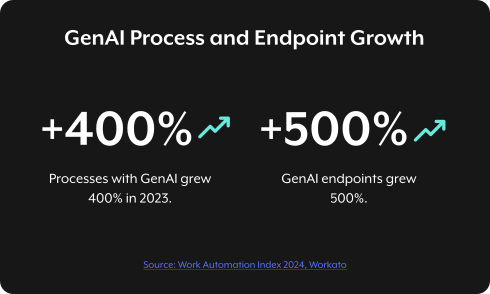
In 2025, generative AI stopped being confined to chat and novelty use cases. As genAI became a workflow pattern, with rapid growth in genAI-enabled processes and endpoints, adoption became more visible and harder to ignore.
AI + CTV in 2026
Orchestration, Trust, and the Shift from Pilots to Production
Executive Summary
AI is embedded, but CIO control is fragmenting.
By the end of 2025, most large enterprises will have AI embedded somewhere in their stack—pilots, copilots, agents, and analytics. But beneath the surface, a small minority now captures disproportionate value. The difference is in how they treat AI and data as one system instead of a collection of tools.
Investment is accelerating faster than readiness.
Most enterprises now assume agents will become part of core operations. But bigger blast radius and less forgiving failure modes create hesitation around letting agents run critical processes without supervision.
Orchestration is the default path to scale.
AI scales across systems, data, and teams. CIOs increasingly treat orchestration as the control plane that connects applications, governs access, and makes outcomes measurable.
What Shifted in 2025…
Start from the business problem down, not the technology up. Pick the smallest thing that drives value, apply the minimally complex approach, then scale from there.
Cameron Davies
Chief Data Officer
@
Yum! Brands

GenAI moved from experiments to measurable workflow activity.
In 2025, generative AI stopped being confined to chat and novelty use cases. As genAI became a workflow pattern, with rapid growth in genAI-enabled processes and endpoints, adoption became more visible and harder to ignore. began competing with the best content in the world in a setting where viewers have settled in to watch, not just scroll.
Early GenAI value concentrated in revenue operations and IT.
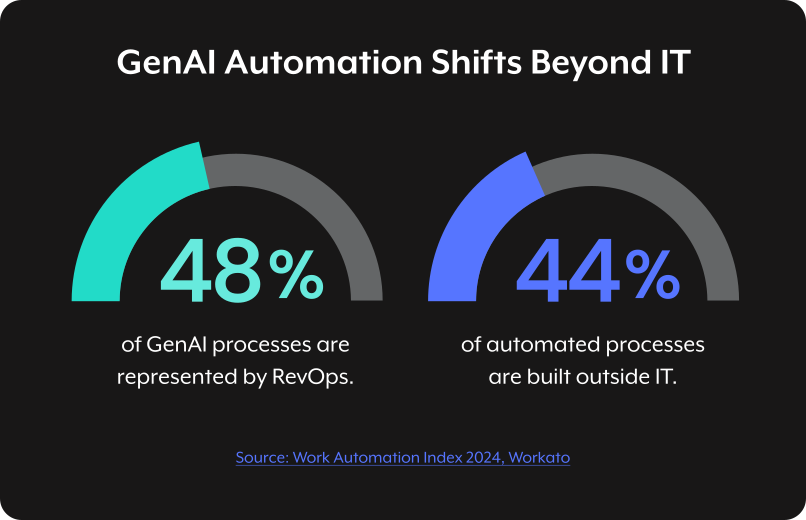
Initial durable wins showed up where work is repetitive, time-sensitive, and tied to pipeline or service operations. Today, nearly half of genAI processes sit in RevOps, and roughly a third sit in IT. That concentration signals a common reality: “scale AI” usually starts with high-volume operational systems, not moonshots. Many of the games that once felt tied to a single broadcast network moved to streaming packages, league-owned apps, and hybrid deals that blend linear and CTV. Fans followed their teams into these environments, bringing strong emotion and household co-viewing with them.
Build” decentralized, and governance followed it.
In many organizations, automation “build” is no longer centralized in IT. Instead, a large minority of automated processes are built outside IT. This is an operating model issue because distributed build creates distributed risk and increases the number of places controls can fail. sit in RevOps, and roughly a third sit in IT. That concentration signals a common reality: “scale AI” usually starts with high-volume operational systems, not moonshots. Many of the games that once felt tied to a single broadcast network moved to streaming packages, league-owned apps, and hybrid deals that blend linear and CTV. Fans followed their teams into these environments, bringing strong emotion and household co-viewing with them.
GenAI moved from experiments to measurable workflow activity.
Most organizations restrict agents to supervised work.
Many leaders keep agents in limited scope (routine tasks) or supervised execution (non-core processes). Supervision lets teams learn, validate outputs, and reduce blast radius while controls mature.
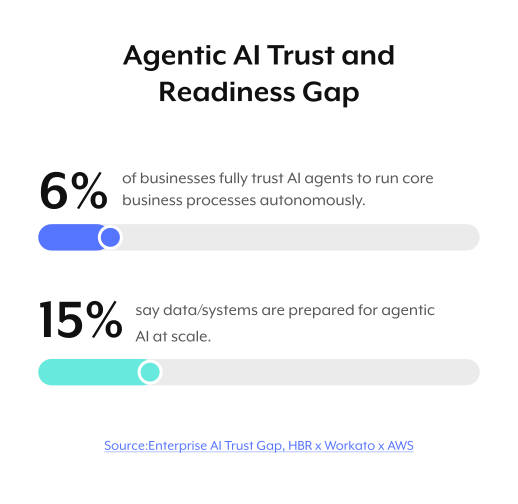
Readiness gaps sit underneath “trust.”
Only a small fraction of organizations fully trust agents to run core processes without supervision. At the same time, most plan to increase agentic AI investment over the next two years. That gap matters when such a small minority say their data and systems are prepared for agentic AI at scale.
Integration debt became a bottleneck to AI scale.
AI value depends on connecting systems and accessing contextual data across tools. Integrations are central to product value, but delivery reliability remains low. This becomes an AI constraint because agents cannot act well across systems that are not consistently connected.
Technical complexity is the main blocker.
Teams are constrained by brittle stacks, fragmented ownership, and the hidden cost of stitching systems together.
AI pressure reshaped integration strategy by default.
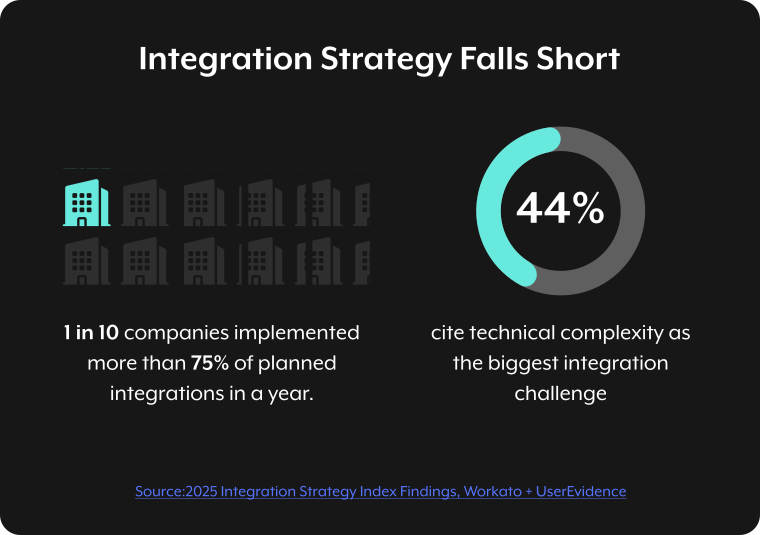
Even as demand rises, delivery continues to lag. Only a small minority of companies implemented most of their planned integrations in a year. Nearly half cite technical complexity as the biggest blocker, which explains why AI “scale” efforts often stall at the integration layer.
CTV buying looks more like digital.
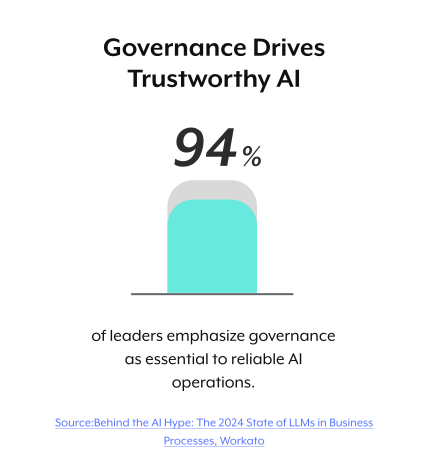
In 2025, governance stopped being a document and started becoming repeatable mechanisms embedded in workflows. Most leaders now treat governance as a prerequisite for reliable AI operations, not a later phase.
“Golden pathways” replaced ad hoc adoption in mature teams.
Leading organizations reduce risk by making safe patterns the default. This lowers friction for builders and reduces variance across projects.
We created guardrails first, then used those guardrails as a spec to build ‘golden pathways’ that abstract complexity and make AI safer to use.
Anthony Moisant
CIO & CSO
@
Indeed
%201.png)
The big problem is AI sprawl. We do weekly reviews: how many new agents were created, what apps are they hitting, and why are three agents doing the same thing?
Shyam Bhojwani
CIO & Head of Security
@
Nextdoor
%201.svg)
Agent sprawl forced governance into weekly operations.
When employees can build agents quickly, duplication and uncontrolled growth follow. The response is operational governance that reviews what exists, what is redundant, and what needs to be retired. in TV have shifted.
Infrastructure decisions started optimizing for AI capability, not legacy parity.
The assumption of cloud and on-prem parity weakened. AI introduced new compute, latency, and platform constraints, and vendors increasingly prioritize AI features in cloud-hosted versions first.
The history of parity between a cloud system and an on prem system, I see that diverging.
Shawn Harrs
EVP & CIO
@
Red Lobster
%201.svg)
Hope is not a strategy.
Pinar Kip Williamson
CIO for International, Risk, Governance and Transformation
@
State Street
%201.svg)
Resilience and geopolitics turned data location into a CIO decision.
Clients, regulators, and boards increasingly ask where data is accessed, stored, and processed. This pressure rises with AI because dependency chains extend across vendors and regions.
Resilience testing expanded beyond the enterprise boundary.
Resilience now depends more on third parties, hyperscalers, and cross-firm dependencies.
Signals from the Field
It’s not ‘do a pen test once a year.’ Now let’s make it continuous—continuous learning, continuous testing—especially with AI, where we run prompt-injection testing automatically.
David Cross
CISO
@
Atlassian
%201.svg)
You cannot legislate math. We learned this in the ’90s with the Clipper chip and encryption debates. LLMs are essentially math, and once open-source capability exists somewhere, you can’t put that genie back in the bottle.
Rex Lee
Chief Information and Technology Officer
@
Canadian Tire Corporation

Digital transformation occurs at the speed of the people. If you ignore cognitive limits and psychological safety, people hide that they aren’t ready, they build parallel workarounds, and the project fails later.
Paulo Sa
Former Executive Board Member & CIO
@
DB Schenker
%201.svg)
People want to be heard. Most organizations communicate top-down, and the message changes by the time it reaches the line of business, so leaders need to create a safe space for honest feedback and be ready to act on it.
Ariel Spak
Vice President and International CIO
@
Aramark

Start from the business problem down, not the technology up. Pick the smallest thing that drives value, apply the minimally complex approach, then scale from there.
Cameron Davies
Chief Data Officer
@
Yum! Brands
Most leaders make decisions with only one third of the data we have. The data exists, teams cannot access it fast enough, so decisions move on without validation.
BK Vasan
Former Chief Data Officer and VP of AI
@
American Eagle

IT people want problems to solve, not a solution to implement. Bring IT into the problem early, let them help solve it, and execution moves faster with less friction.
Ken Knapton
CIO
@
WIN Brands

The CIO Playbook for 2026
1. Start with workflows, not tools.
Pick a small set of workflows tied to revenue, cost, risk, or experience. Use integration and automation data to find where work is high-volume and cross-system. Measure outcomes from the start.
2. Define governance before autonomy.
Define what agents can do, who they act for, and where humans must approve. Treat agent permissions and identity as first-class design requirements, not implementation details.
3. Fix “ready data” before deploying more agents.
Agents amplify whatever data environment they inherit. Standardize definitions, clean core entities, and make context traceable before expanding autonomy.
4. Modernize integration and orchestration as one program.
Treat integration throughput, governance, and observability as AI constraints. Build reusable patterns and reduce brittle point-to-point connections so agents can act reliably across systems.
5. Measure outcomes with experience-level metrics.
Shift measurement from tool adoption to workflow outcomes. Track cycle time, error rates, rework, time saved, and context switching by function. Use the same metrics across IT and the business so results stay comparable.
6. Prove ROI with fast, credible internal wins.
Prioritize internal workflows that leaders can validate quickly. Use those wins to fund the hard work of orchestration, data readiness, and governance.
CIOs Beyond 2026
AI will reward CIOs who treat it as an operating model change
In 2026 and beyond, the new competitive divide is whether organizations can govern autonomy, connect systems fast enough to scale, and build trust that holds under real business pressure. Ultimately, orchestration, integration throughput, and data readiness will determine whether AI becomes a durable advantage or compounding operational risk.
Methodology
This editorial report draws on a mix of real-world insights and industry data to reflect a reality already visible to advertisers, sellers, and viewers.
First, we synthesized findings from Workato research programs to establish the quantitative backbone of the report. Then, we conducted interviews with CIOs, CISOs, CDOs, and senior technology leaders across sectors including financial services, retail and hospitality, logistics, consumer technology, enterprise software, higher education, and industrial environments. Many of these conversations also inform standalone feature stories published on CIONews.com.
Finally, the editorial team compared themes across research data and interview transcripts to identify what changed in 2025 and what disciplined CIOs are doing next. The result is a 360-degree snapshot of the CIO’s operating reality, plus a practical stance to scale agentic AI without losing control.