
While AGI Dominates Headlines, Banking Leaders Make Strides In Practical 'Enterprise General Intelligence'
Wells Fargo's Bijit Ghosh on why the architecture decisions CIOs make now will determine which AI programs hold up at scale
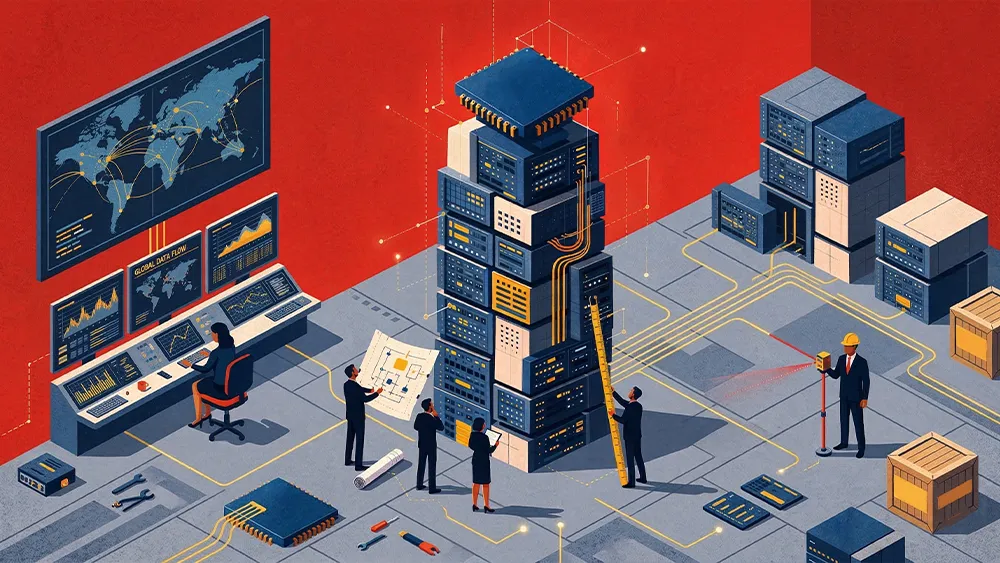

Enterprise AI is only as durable as the infrastructure beneath it. As financial institutions scaled agentic systems from pilot to production, the distance between a working deployment and a governed one was widening, and the gap was almost always architectural. Organizations that built without architectural flexibility found that agents stalled when domain complexity outpaced system design. The question was no longer whether to build intelligent systems, but whether the underlying stack was structured to support them at scale.
Bijit Ghosh is a Managing Director at Wells Fargo, specializing in AI, data, and cloud transformation. A recipient of the MachineCon Global AI-100 Award, Ghosh has spent his career embedding large-scale AI and data platforms into the core of regulated industries, with previous modernization work at Deutsche Bank and BNY Mellon. His view is that the infrastructure decisions made today will determine whether agentic ambitions are held up at enterprise scale. "We are not building AGI. We are building enterprise general intelligence, where the enterprise, not the model, defines the control, governance, and augmentation required," he said.
A three-tiered blueprint: Ghosh's architectural framework moved deliberately from the infrastructure layer up, starting with event-driven infrastructure, building to a flexible model platform, and culminating in an agentic layer that served as the primary execution engine for business processes. The practical result was a system in which agents collaborated across functions rather than operated in isolation. As this model matured, a growing market shift toward Outcome-as-an-Agentic-Solution (OaaS) frameworks reflected a broader appetite for guaranteed business results over the underlying technology. "It could be a decentralized agent network where a payment agent is talking to an investment banking agent, or a post-trading agent is talking to a payment agent for liquidity. The driving force is the shift from task-specific agents to cross-functional ones," Ghosh said.
The gap between deployment and durable governance was becoming the defining challenge, and the organizations closing it were the ones that treated controllability as a design requirement from the start. Investment in enterprise AI observability and governance tooling was accelerating because the industry recognized what was at stake. The architecture decisions organizations made would define which ones were positioned to scale.
Governing the sprawl: As AI scaled across the organization, the risk of shadow AI, where individual departments built bespoke solutions outside any central framework, became a structural liability. Without a unified standard, teams optimized locally while the enterprise lost coherence at the stack level. Ghosh said that countering this required more than a policy memo. "We need to make sure everyone is aligned to a North Star, with proper benchmarks that match enterprise metrics, KPIs, and workflows, and a clear definition of what sits above or below the human-in-the-loop threshold."
A glitch in the system: Mandatory human oversight was a non-negotiable in financial services, but at scale, it created a serious problem. Ghosh saw this as a structural tension that could not be resolved by adding more reviewers. "The agent shrinks whenever the confidence score or risk profile changes, and that creates bottlenecks. We have to create standardization as part of our policy and governance so agents can operate within a proper, collaborative framework," he said.
Code as control: The organizations moving fastest on agentic AI were the ones treating governance the same way they treated cloud transformation. Rather than bolting compliance on after deployment, they embedded it as a technical standard from the start. Ghosh drew a direct parallel between the two. "We had a lot of learnings from cloud that we tried to standardize in our model, our data, and our agents as a governance stack. That is where the shift becomes more concrete in terms of how you become modular first, and then scalable," he said.
The architectural shift Ghosh described was not happening against a stable backdrop. As frontier models grew more capable, the assumptions underlying agentic builds were already changing, and the organizations designing for adaptability were better positioned than those optimizing for the current state of the technology.
Mind over matter: The implication for enterprise AI teams was significant. "As the capabilities of the underlying models become significantly more powerful, the amount of custom scaffolding required by agents will be reduced, eventually becoming obsolete," Ghosh said. What took substantial development work at the time would become a configuration choice, freeing teams to focus on higher-order priorities like orchestration, governance, and business logic.
Crawl, walk, run: A phased rollout aligned to established standards like ISO 42001 was Ghosh's prescription for organizations that wanted to scale without losing control. The first phase centered on asset clarity, understanding what the organization had before deciding what to automate. The second built confidence on both sides of the human-agent relationship, creating the conditions for continuous knowledge transfer. The third phase connected the operational layer directly to business outcomes. "By the third phase, the system starts to self-improve in a way that is measurable and governed," he said.
The question facing enterprise AI leaders was no longer what to build, but how to build it in a way that held up as the technology beneath it continued to shift. For Ghosh, that meant architecting for interoperability and portability from the start, so that vendor lock-in never became a ceiling on what the system could become. "Our focus must shift to building a central brain. This orchestration layer can handle planning, routing, retries, and create interoperability, regardless of which model we are working with," he said.

If this caught your attention, that’s not accidental.

The best editorial systems don’t happen by accident. Outlever builds them.