Inside Experian's Equation For AI Trust: Experience, Partnerships, And Open Ecosystems

“We have a unique position where we knew we could work with these partners in a collaborative way so the technology would be complementary. Everyone does what they do best, and we could ensure the transactions move end-to-end with that trust."
.avif)
Across the digital world, our identities are constantly verified. From dating and payment apps, to social and professional networks, we’re now accustomed to seeing checkmarks next to names and pages that indicate the person or business is who they say they are. Now, the race is on to find an equivalent for AI agents. And the technology’s future may depend on it.
Today, a lack of trust is holding back AI progress. While comfortable using AI as a search engine, many individuals and businesses aren’t yet ready to turn over full control to these systems. They’re nervous AI could go rogue and damage their lives or operations. Just 25% of Americans trust AI in the retail setting, according to a recent study.
Experian isn’t the first company to try to solve AI’s trust problem. But with a long history of verifying identities and stopping fraud, along with a partnership-first approach, the company is trying to create the open ecosystem to power the agentic economy. The company recently introduced Experian Agent Trust, a new framework launched in collaboration with Visa, Cloudflare, and Skyfire intended to give consumers and businesses the confidence to let AI agents start to autonomously transact.
While solving the identity challenge in agentic commerce is the early focus, Experian Agent Trust could ultimately serve as the new foundation for trust across AI use cases, from doing taxes to managing a company’s supply chain operations, according to Chief Innovation Officer Kathleen Peters.
“We have a unique position where we knew we could work with these partners in a collaborative way so the technology would be complementary. Everyone does what they do best, and we could ensure the transactions move end-to-end with that trust,” she told CIO News.
Authorizing and authenticating the identity of AI agents is a problem that spans beyond a single vendor. AI agents don’t just work in one ecosystem, but throughout different underlying environments. A user’s identity must be carried through all these interactions. Otherwise, in the case of commerce, the corresponding AI agents could be blocked by content delivery networks, or CDNs, from Cloudflare and others designed to prevent bots from harvesting website data.
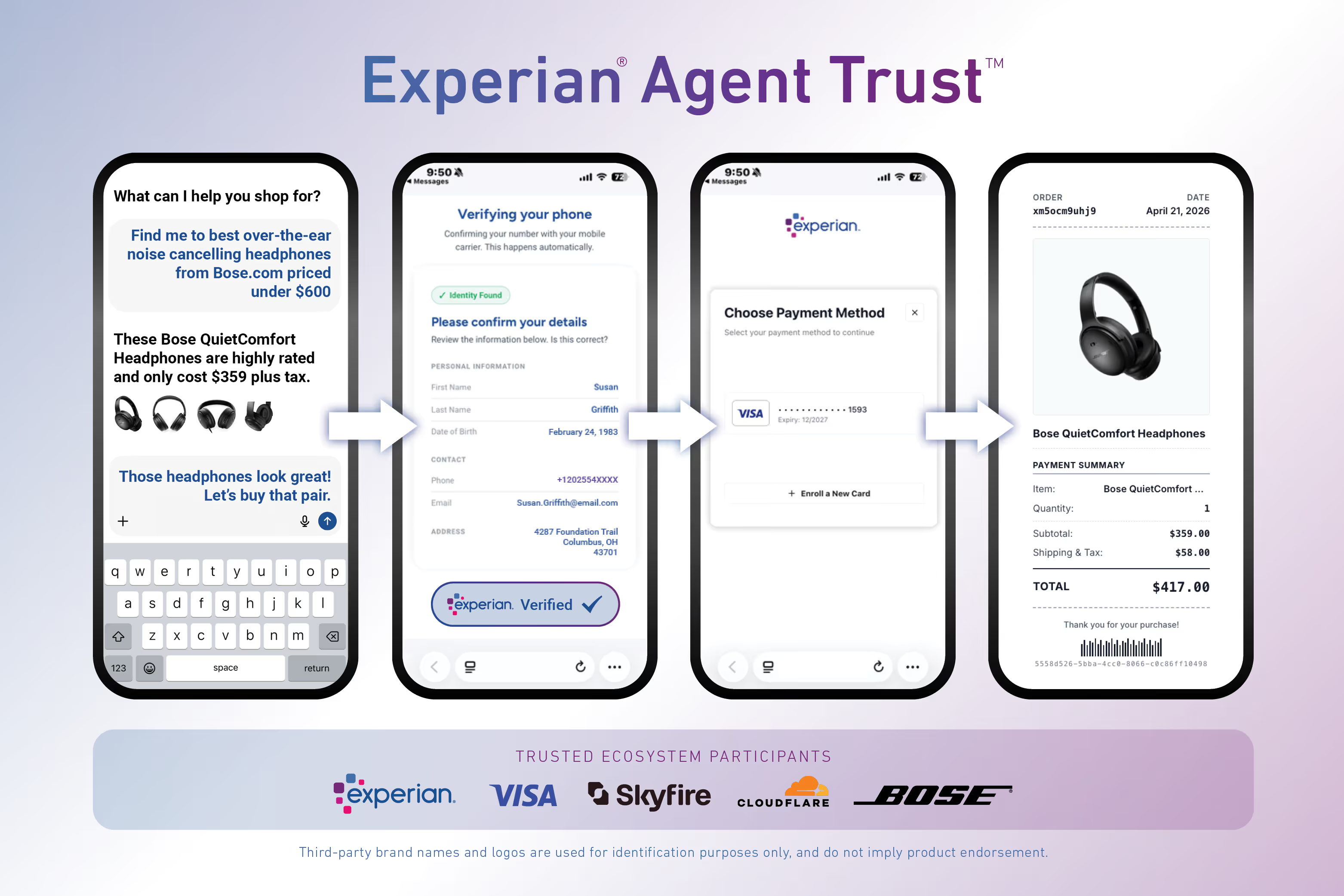
Tokenized through an open protocol called KYA (or “Know your agent,” a play on “Know your customer” requirements in the financial industry), Experian Agent Trust functions like a “digital passport” for users. With standard account information, along with soft verification techniques, the system confirms whether individuals are who they say they are. When the identity is established, the AI agents carry it with them through every interaction. As a result, they’re then able to bypass bot blockers to navigate websites, find inventory, and transact on the user’s behalf.
This is where the partnerships are key. Visa Intelligent Commerce, for example, delivers the secure commerce experience. There are also safeguards in place to prevent authorized purchasing, including enabling the merchant to verify high-priced transactions. And retailers don’t have to share their inventories with third-party LLMs.
“Consumers just want to be able to shop, and merchants just want to be able to sell goods,” said Kathleen. “With an open ecosystem, that's how we will have the most choice and convenience, and that's how AI is going to scale.”
Next up, Experian will continue to try to bring new partners and participants into the ecosystem — and, of course, navigate the growing competition from others also trying to build AI’s new trust layer. The race is good reminder: While AI’s raw power may be growing more impressive, trust is still the biggest barrier to mass adoption.

If this caught your attention, that’s not accidental.

The best editorial systems don’t happen by accident. Outlever builds them.